
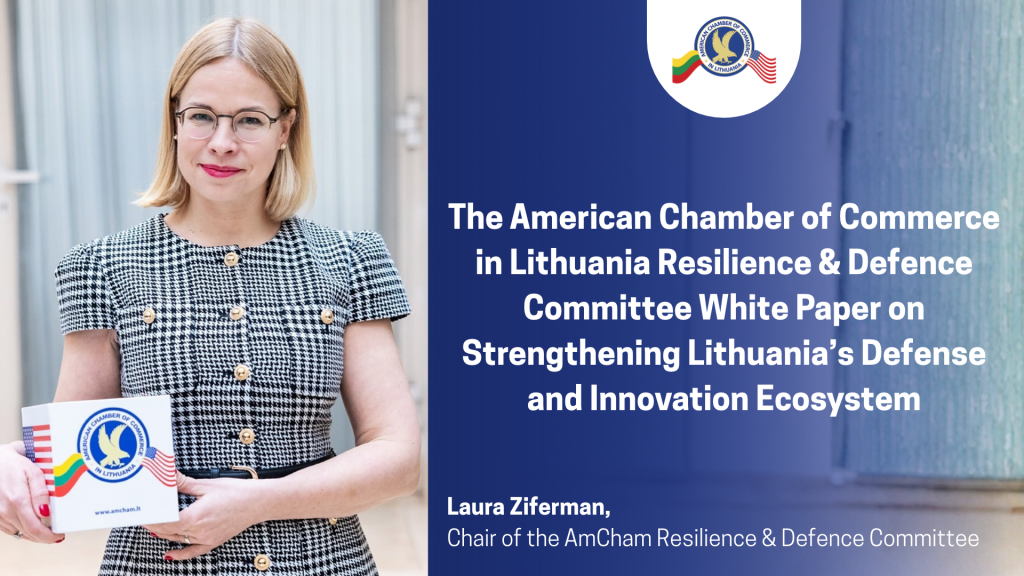
The American Chamber of Commerce in Lithuania Resilience & Defence Committee White Paper on
Strengthening Lithuania’s Defense and Innovation Ecosystem
How can Lithuania turn growing defence investment into stronger national security, competitive businesses, and lasting economic value? A new White Paper by AmCham Lithuania’s Resilience & Defence Committee sets out concrete recommendations to help achieve this ambition.
Bringing together the perspectives of Lithuanian and international companies in defence, cybersecurity, IT, engineering, and advanced technologies, the White Paper calls for closer cooperation between government and industry to strengthen Lithuania’s defence capabilities, technological sovereignty, and domestic industrial base.
Its central message is clear: Lithuania’s security and economic future are closely connected. Increased defence investment offers an opportunity to develop local manufacturing, accelerate innovation, and strengthen Lithuania’s position within NATO and EU defence markets. Realising this potential requires clear priorities, effective institutions, and predictable opportunities for businesses to contribute.
The Committee identifies a gap between strategic commitments and practical implementation. Although Lithuania has established defence industry priorities and support measures, the White Paper argues that companies still face fragmented information, uncertain procurement opportunities, financing barriers, and unclear institutional responsibilities.
To address these challenges, it outlines six priority areas.
1. Turning strategic ambition into measurable results
The White Paper calls for an operational national defence industry strategy with clear targets, defined responsibilities, and annual progress reviews.
Defence investment should be linked to measurable outcomes, including domestic value creation, local industry participation in procurement, and export growth. Priority technologies and capabilities should also be supported by concrete state purchasing and investment commitments, giving businesses the confidence to invest in facilities, skills, and production capacity.
2. Making defence procurement more predictable and open to innovation
Predictable procurement is essential for companies planning long-term investments. The Committee recommends publishing a defence procurement plan covering at least five years, updated annually and accessible to the extent permitted by security requirements.
The White Paper also proposes allocating at least 10% of annual defence procurement expenditure to innovative procurement, including pilot projects, prototypes, and pre-commercial programmes.
Earlier engagement with industry, systematic consideration of credible domestic solutions, and a review of barriers to participation would help procurement support both military needs and local industrial development.
3. Building domestic manufacturing and supporting SMEs
The White Paper highlights the importance of developing Lithuania’s own manufacturing capacity alongside participation in international supply chains.
A key recommendation is for the state to act as a first buyer of domestic defence innovations, helping promising technologies move from development and testing to practical deployment. Clear testing procedures, faster procurement pathways, and a dedicated SME action plan would make it easier for smaller businesses to enter the sector.
The Committee also proposes establishing a national defence industry holding to coordinate state-owned and state-affiliated defence assets, investment, and production capacity, while supporting international partnerships.
___________________________________________________________________________________________________________________________________________________________________________
READ THE FULL WHITE PAPER HERE>>
___________________________________________________________________________________________________________________________________________________________________________
4. Positioning Lithuania as a hub for Ukraine–EU defence industrial cooperation
The White Paper identifies cooperation with Ukraine’s defence industry as a strategic opportunity to connect battlefield-tested technologies with Lithuanian industrial capabilities and European markets.
It recommends developing a clear, competitive offer for Ukrainian defence companies, covering business establishment, financing, certification, and access to procurement contacts.
The Committee also proposes building on Vilnius’s role in NATO–Ukraine defence innovation by seeking to make the city a permanent centre for this cooperation, supported by structured testing and procurement opportunities.
5. Making financing accessible throughout the development cycle
The Committee calls for a systematic review of why existing financing instruments are not reaching their full potential.
Recommendations include a single platform bringing together funding opportunities, eligibility criteria, and application guidance, alongside risk-sharing mechanisms such as loan guarantees and co-investment structures.
Dedicated support for accessing EU defence funding would help companies move from early development to production at scale. Clearer long-term state demand would further strengthen investor confidence.
6. Simplifying regulation and clarifying institutional responsibilities
The White Paper stresses that existing support mechanisms must work effectively in practice.
It calls for a functional one-stop shop with named responsible officers, clear response timelines, and a documented pathway from initial enquiry to testing and procurement consideration. It also recommends a fundamental revision of the Law on the Control of Arms and Ammunition and benchmarking Lithuania’s regulatory environment against leading regional and NATO partners.
Businesses need a clear, accessible source of information on procurement, financing, regulatory changes, and national defence industry priorities.
Moving from recommendations to implementation
To advance these priorities, AmCham’s Resilience & Defense Committee proposes the establishment of a permanent, structured public-private dialogue between AmCham and the Government of the Republic of Lithuania, in the form of regular – for example, quarterly – Policy Labs. These Policy Labs would bring together representatives of MOD, the DRA, the Innovation Agency, ILTE, Invest Lithuania, and the business community to examine concrete barriers and develop practical solutions. Their objectives would be to: (i) identify the principal regulatory and cooperation barriers to defense industry development; (ii) develop specific, actionable proposals for addressing them; (iii) sustain a productive, ongoing dialogue between the Government, the defense industry, and the innovation ecosystem; and (iv) facilitate the exchange of information and best practice to support innovation in the defense sector.
The window of opportunity is real – but narrow. The decisions made in the next two to three years will determine whether Lithuania emerges from this period of increased defense investment with a stronger, more competitive economy, or whether that investment flows largely abroad.
The American Chamber of Commerce in Lithuania invites the Government of the Republic of Lithuania to discuss the findings and recommendations of this paper within the proposed Policy Lab working group – and to move from discussion to implementation. We are ready to begin.