
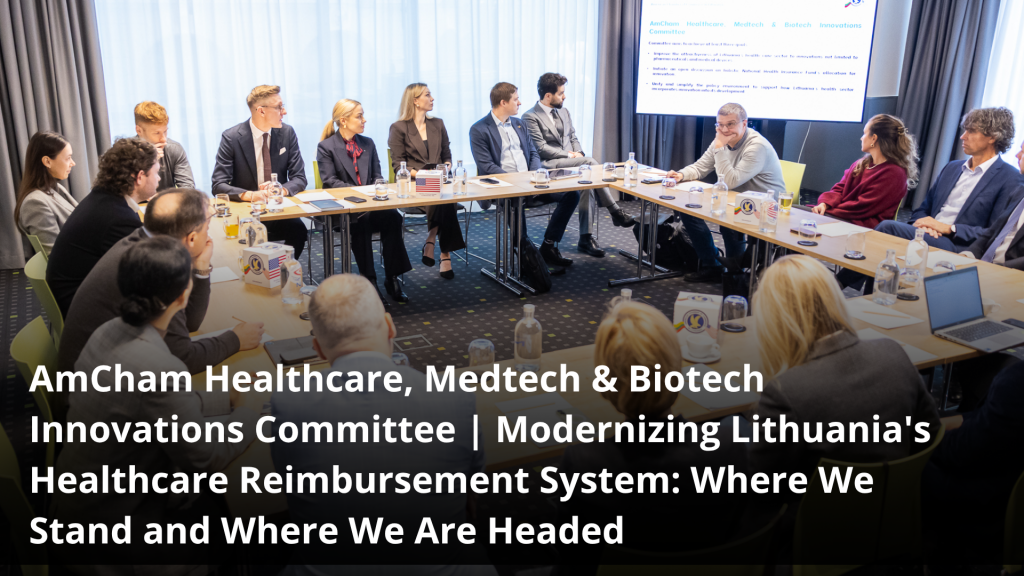
The American Chamber of Commerce in Lithuania continues to work with the Ministry of Health to ensure that patients gain faster access to innovative medical technologies. As we build on a year of progress, we review what has been achieved and what’s next.
Over the past year, the American Chamber of Commerce in Lithuania’s Reimbursement of Medical Devices Working group has been actively working to improve the pathway through which innovative medical technologies reach patients in Lithuania. This work has not remained theoretical – it has been reflected in concrete policy dialogue, published documents, and direct engagement with government institutions.
What Have We Accomplished?
In 2025, the working group developed and published a White Paper outlining the key challenges faced by medical device manufacturers seeking reimbursement within Lithuania’s compulsory health insurance system. The document identified structural barriers – from the complexity of the submission process to insufficient industry involvement – and provided specific recommendations for addressing them.
An important milestone was a meeting with the Vice Minister of Health, during which working group representatives presented these findings and outlined opportunities for further collaboration. The dialogue took place in a constructive spirit, and the Ministry expressed its readiness to continue the engagement.
Encouraging Signals From The System
Alongside our dialogue, the Ministry of Health and the National Health Insurance Fund (NHIF) have reorganized specific reimbursement pathways. As of January 2026, the section of the List of Centrally Reimbursed Pharmaceutical and Medical Aid Products (Centralizuotai apmokamų vaistinių preparatų ir medicinos pagalbos priemonių sąrašas) concerning medical devices has been removed.
The medical devices previously covered under this section have been transferred to the List of Personal Healthcare Services Reimbursed from the Compulsory Health Insurance Fund (Privalomojo sveikatos draudimo fondo lėšomis apmokamų asmens sveikatos priežiūros paslaugų sąrašas). Accordingly, the submission form related to this list has been completely redesigned – not just updated in structure but expanded in scope and level of detail.
This is a welcome development: it signals that policymakers are actively seeking a more transparent and coherent approach to integrating innovative medical technologies into Lithuania’s publicly funded healthcare system.
Areas That Merit Attention in The New Reimbursement Process
The reimbursement application form has grown from around 5 pages to 22 pages across four sections, and responsibility for submission has shifted entirely to hospitals and clinicians. The evaluation criteria also raise questions – while the form applies to healthcare services broadly, many such services are built around medical devices, and it remains to be seen whether the scoring framework is fully suited to device-based therapies, as distinct from pharmaceuticals.
The system has been in operation only since January. It would be premature to draw firm judgments – what matters now is observing how it works in practice and whether previous challenges were solved. The working group’s priority is to monitor the first submissions, gather experience from hospitals and clinicians navigating the new process, and continue dialogue with the Ministry of Health and the NHIF. We remain hopeful that this will be a collaborative effort.
Lithuania’s healthcare system is on a path towards greater transparency and efficiency. The American Chamber of Commerce in Lithuania remains an active partner along the way – not only raising concerns but working towards solutions together.